Thursday, December 1, 2011

McCarthy, Alaska - Part 1

The weather, as expected, threatened rain, and as I rode out beyond the outskirts of the city and moved into more open land, a blanket of clouds obscured my view. The ride, three hundred miles along the beautifully paved Glennallen Highway, is supposed to be some of the most spectacular scenery in Alaska, but the cloud cover made it nearly impossible to see anything. I stopped only a few times to take pictures, once in an attempt to photograph a glacier that was visible from the road.

This was probably the clearest the weather got on the ride.

I knew that there was a spectacular view there, I just couldn't see it...

A close-up of the glacier.

Not having the distraction of awe-inspiring views, I hunkered down to the task of making the trip as quickly as I could. I had gotten a later start than I had wanted to, and, never having experienced the McCarthy road before, I didn't know how long that would take me once I left the relative ease of the paved highway. So, one hundred and eighty miles and three and a half hours later, I pulled into the only gas station for miles, at the end of the Glennallen Highway where it meets up with the Richardson Highway; known to the locals as "the Hub".

A fine rain had been falling, and it was a relief to get off the bike, fuel up, get inside, and take a break. I called my friend Elizabeth, who didn't sound as confident as I would have wanted her to be about my arriving at a decent hour. But, with the trademark laugh that I remembered so clearly from twenty years ago in college, I knew that she was finding the notion of my adventure amusing nonetheless. She would wait up for me, she said, but that I should call again before I got onto the McCarthy road, as she needed to give me more directions, and that it would be the last point at which I could get cell service.

While suiting up and preparing to head out, a man approached me. From his appearance, I assumed that he was a biker; jean jacket, boots, long hair, scraggly beard; unusually tall and angular, looking as though he had been carved from a tall, thin tree trunk, the bark left behind where his wrinkled face now was. After asking me where I had come from and where I was going, he told me of how he had initially come to Alaska from the lower 48 back in the late 1960's, making the entire ride on a motorcycle. Back then, he explained, there was nothing to accommodate travelers of any kind on the Alcan Highway through Canada, and that he and his friends had several close calls while making there way out, one of them damaging his bike so badly that he had to abandon it on the side of the road and hitchhike the rest of the way. When I told him I was heading for the McCarthy road he looked at me, looked at my bike, and nodded in quiet approval. In the motorcycle world, that was as good as a blessing from the Pope, and I climbed back on my ride with a little shot of adrenalin mixing with the blood in my veins, ready to take on the last leg of the trip.

The sixty miles to get to the McCarthy road went uneventfully, but I began to notice just how desolate things were becoming. Along the Edgerton Highway, the last thirty three miles before the start of the McCarthy road, towns were becoming more infrequent (not that they had ever been that frequent anywhere else in Alaska, mind you), and the few I did pass became smaller and smaller. I called Elizabeth before I passed through Chitina, the last town before the end of pavement and the start of gravel. She told me that when I did reach the end of the McCarthy road, there was a phone at the base of the footbridge into town. I could call her from there to get the last of the directions. Again, I heard apprehension in her voice, but I chose to ignore it.

When I approached the entrance to the road, a narrow cave-like separation blasted out of rock, I knew that there was no turning back. For the first mile or so it didn't seem like it was going to be that bad, but as I ascended a small climb that overlooked a river, the gravel became thick, and all of a sudden I found myself fighting to keep the bike tracking straight. I downshifted, fighting to keep the bike upright. At this pace, it was going to take me hours to make the trip. And it did.

You're not kidding...

The passage that marks the beginning of the McCarthy road.


Passing over the first, and probably only sizable landmark on the road, the Kuskulana Bridge at mile 17, I stopped. At 238 feet above the river below, it took everything I had to get close enough to the edge to take a picture, and I remembered reading in the Lonely Planet guide that, until recently, the one lane bridge had consisted of only two planks and no guardrail, something that would have probably had me turning the bike around right there and then...

The bridge was scary enough as it was - I couldn't imagine what it was like before it was renovated!

Yikes.

The miles dragged on, and even with the longer hours of daylight, dusk was starting to settle in. My hands, just as on the road to Manley, were starting to cramp up, and I could no longer ignore the soreness in my back and arms. I tried to keep my focus on the road, maneuvering around potholes and loose gravel, knowing that the more tired I became, the more chances I had of making a mistake.

20 miles to go...

Two and a half hours later, completely exhausted both physically and mentally, I reached the footbridge at the Kennecott River, and I rang Elizabeth on the payphone at its start. Even though cars were not allowed in McCarthy, she told me it would be fine for me to cross the ultra-narrow footbridge on the bike, and that I should then make my way about a mile or two past the town, turning right on a trail that dipped into the woods. I asked if the trail would be safe for the bike, her answer only being that she and her family drove it on their four wheelers. Too tired to question her further, I set out again, assuring myself that it would be fine. I motored carefully across the footbridge, heading out on the gravel road that lead to McCarthy.

This section of road turned out to be just as pitted and precarious as the rest, and when I finally arrived at the turnoff, I mentally crossed my fingers, pointing the bike into the woods. The first section of the trail wasn't so bad, but as I drove on, the sky truly dark now, I had to ride with both legs extended, as the road became a sea of ruts, rocks and loose earth, and keeping my feet out was the only insurance I had that I wasn't going to tip the bike over. I was bottoming out constantly, though, and I feared that I wouldn't have the strength to keep the bike from falling, let alone the strength to pick it back up if it fell. At one point a run-in with a rock threw me backwards, and my hand, locked tightly to both grips, unintentionally gunned the throttle. It was shear luck that I had the reflexes to grab hold of the clutch lever and brake in time as the engine roared and the bike blasted forward, the rear wheel fish-tailing in the mud. If I hadn't, I would have certainly collided with the trees ahead of me.

My mind was racing now, adrenaline having every nerve in my body on high alert as I fought to control the bike with all the strength and focus I had left. When I struggled through a particularly thick section of rocks, though, the underside of the bike crashed into one, the shock of stone colliding with metal shooting straight through my body. The sound of the bike changed almost immediately, the engine much louder now, with a throaty rattle that I had never heard from it before. I assumed I had punctured the exhaust, but I was in no position to stop and investigate. I pushed forward for another mile or more, finally seeing hints of my destination in the form of hand made "slow down - children at play" signs. And suddenly, as if out of nowhere, I saw Elizabeth standing on the trail, illuminated only by my headlights.

It was an unusual way for two people who hadn't seen each other in almost twenty years to meet again, but after parking and unloading the bike, we hugged and laughed, and I followed her into the house, still somewhat in shock over what I had just been through. It was dark now, and all I could make out was the illuminated windows as we made our way along the short path to the yurt.

Her children Avery, age eleven, and Owen, age eight, were naturally shy at first, but seemed to warm up to the idea of a stranger coming to stay with them fairly quickly. It was late, though, and I had very little left in me to make good company. Elizabeth showed me to the guest cabin, where a fire was already roaring in the stove. I fell to sleep immediately in the comfort of the warm room, not stirring once all night.

The family yurt; two floors of wood heated, solar powered awesomeness!

The kitchen.

The unmistakable feature of any yurt; the round skylight.

The guest cabin - the room I stayed in was on the second floor, above the bear-proof storage area below.

Reduce, reuse, recycle; the kids playground.

This was the outdoor shower, which was heated by the custom built wood-fired stove to the left.

A close-up of the stove - it also heated the water in the yurt for doing dishes.

The outhouse, complete with emergency whistle just in case a bear decides to stroll by... or if you run out of toilet paper.


Owen putting his shoes on before we make our way out for a hike.

Avery, taking advantage of the good weather.

My time with Elizabeth and the kids was nothing short of idyllic. I watched in amazement at the routines of there lives in and around the house. Without electricity, sewer or "conventional" water, incredibly creative solutions had been devised over the years to make the home livable; gravity-fed fresh water was pumped in via PVC pipes that linked to a nearby stream uphill; a small solar panel on the roof made the most of the available sunlight; a specially-made wood burning stove stood ready to heat the water for the outdoor shower as well as the kitchen sink; another wood stove inside served as the home's only heat source, and a composting outhouse was situated out back. What most of us would consider incomprehensible conditions, they simply treated as any other day in their lives.

I tried my best to blend in with their routines, helping to start a fire to heat the water for washing the morning's dishes, or sweep the kitchen floor that seemed to perpetually collect dirt. I would still watch in amazement, though, as Avery would, with very little prompting from her mother, step outside to chop wood with a hatchet that was almost as big as she was, or as Owen would open the "rot box", a compartment under the floor of the kitchen that served to keep food cold in lieu of a refrigerator, pulling out food to prepare his own lunch. The kids were more independent than any that I had every come across, but there was no pretense in any of their actions. They put no more thought into chopping wood as anyone else would think of turning up the thermostat; it was simply what needed to be done.

It was unfortunate that I wouldn't have the opportunity to meet Elizabeth's husband Howard, who, back in the eighties, became one of the pioneering figures in making McCarthy what it is today. The family spent most of their winters in a condominium in Anchorage, as Howard was a school teacher there, and since the school year was fast approaching, he had already returned to prepare for classes. McCarthy was not big enough to support a school, and so the kids attended the public school in Anchorage, which was also starting soon. This did afford me, though, plenty of time to catch up with Elizabeth, each of us filing the other in on all the goings on of our mutual college friends that one or the other had lost touch with, as well as our respective families. For me, it was as though no time had gone by at all; Elizabeth looked exactly the same as she had twenty years ago, and she was living the life that she was clearly destined to be, even based on the person I knew back in college. There are few of us in life that can say that we have truly made the life that we dreamed for ourselves at the age when optimism and idealism are at their highest, and being at the house, witnessing the reality of this taking place all around me, was an absolute joy.

 Her children, unencumbered by the distractions of television, the internet, or any number of other things that prevent children from using their nature instincts to explore the immediate world around them, were too busy playing, reading or making art to ever miss any of it. On one particular day, I found Avery combining two of those activities into one, which I captured on the video below...


I made several trips to the Kennecott mine to photograph while staying with Elizabeth and the kids (the walk was no more than half a mile), and since Elizabeth had worked at the mine as a tour guide, I was able to get the inside scoop on the history of the place, as well as a look into some areas that are usually off limits unless you're taking an official (a.k.a. paid) tour.  Even the kids, having heard their mother recite the stories so often, started giving me all the information themselves, and as we made our way through some of the main refinery buildings, they eventually took over the "tour" completely!

The view of the Kennecott mine a short walk from the house.

 And this is a video clip that gives you a much better understanding of just how expansive the view really is:


One of the photographs I took inside the recently renovated women's quarters that was once part of Kennecott mine.

You're never too far from home...


I also had the opportunity to ride the four and a half miles back into McCarthy with Elizabeth one day, finally getting to see the historic "downtown". Apparently the town got its start at the turn of the twentieth century because Kennecott forbid both alcohol and prostitution, both of which McCarthy was more than happy to supply in spades to the miners. When the mine shut down in the late 1930's, the town all but died, and it was practically abandoned until the 1970's. But even now, as of the latest census, there are only 42 people living in McCarthy, and I don't think that all of them are even year-round residents. Tourism has replaced the debauchery of a hundred years ago, and now people come to McCarthy to hike the glacier, take a plane ride, raft the Copper River and tour the nearby mine. Here are a few pictures to give you a sense of the place:

Creative uses for abandoned vehicles.

The old hardware store is now the home of the Wrangell Mountains Center, a supporter of environmental and arts education.

Now you know that people were up to no good in here back in the day...

Elizabeth, checking the time in the place that time forgot.


One of the most exciting things I had the opportunity to do while staying in McCarthy was hike on the Kennicott glacier that stretches along the valley below the mine. We filled our day packs, borrowed crampons from the National Park Service office (another perk of Elizabeth's former affiliation with the park), and made the hike to the base of the most navigable section of the glacier. The views were stunning, and there is something indescribable that came from traversing something not only so vast, but also ever-changing. Glaciers expand and contract at a pace that is imperceptible by a days observation, but knowing that they do makes it almost feel as though you are walking on a living, breathing organism; both thrilling and humbling at the same time. Below are some of the pictures from that day:

Believe it or not, that's ice underneath all that gravel.


The happy hikers!


The first look at the hike-able section of the glacier.


There were several groups hiking the glacier at the same time - this is the ascent that starts the hike, which can be a little tricky if you're not used to wearing crampons.


Crampons - like having big, metal teeth on the bottom of your feet - but in a good way!

The intrepid hikers.

Sometimes it wasn't the really big stuff that was the most impressive...

Avery checking out the running water from above...

...and then all of us checking it out from below.


Dori, the wonder dog - ever vigilant!


C'mon, I had to get this shot!


And, of course, some video to put it all in perspective...


After five days, it was time to pack up my things and get back on the road. Elizabeth was driving with the kids back to Anchorage, as they were starting school the next day, and her husband Howard had already started his school year of teaching. I had thought little of my bike and the sound that it had made after hitting the rock on the trail, but a quick inspection the day before had reveled no signs of problems; no holes, no leaks; nothing. I started her up and drove out to the edge of the trail. The engine was still unusually loud, and after lugging out my gear and going through the now completely familiar routine of lashing everything up with bungy cord, I sat down on the bike, still perplexed as to why it was making that noise.

For no particular reason, I decided to take a look at the oil level, even though I had just changed the oil in Anchorage and knew that I had topped it off correctly. What I saw in the circular window close to my right foot threw my brain into shock; it was empty. I looked again, hoping to see something different, but the small glass window was as clear as it had been a moment before. I climbed down on the ground next to the bike, looking for some sign of a leak, and there, almost hidden from view, was a circular, threaded opening on the side of the crankcase, exposing far more of its insides than it should have. It appeared to be another drain plug for the engine, and the rock I had hit had clearly made a direct hit on the cap, sheering it off completely. I had run the bike those last few miles on the trail completely without oil.

As I lay on the ground in shear disbelief, the reality of my situation started to swirl around in my brain. Here I was, three hundred miles from anywhere that would even remotely have a facility able to acquire the part to replace, and even if I was able to get it, I had no guarantee that it would completely fix the leak. And on the off chance that I did and I was able to get back on the road, what would the effects of having run the engine without oil be - would the engine even survive the 5000 mile journey home? I was starting to panic, and for the first time since I had set out on this journey, I truly believed that I had found myself in a situation that no luck in the world could fix...

Anchorage

My bike seemed to be running fine, and I once again welcomed the possibilities that always reveled themselves with open road. Seventy miles south of Talkeetna, I crossed the city limits of Wasilla, made famous as the hometown of Sara Palin. Curiosity got the best of me, and, after a quick stop to fill up with gas, I followed my nose to a local "city" market that was being advertised with small signs strategically placed throughout town. The market turned out to be about as empty as the former governor's head, but I did get to sit and enjoy a piece of homemade cherry pie while listening to an unlikely musical duo perform everything from Willie Nelson to Bob Seger.

Funny, I couldn't see Russia from anywhere in town...

And this was the busy section... actually, it was the only section.

Would "trim that beard" be enough of a tip?

I even got some video... and all kidding aside, they were actually a lot of fun to watch.


With only 45 miles to go, I climbed back on the bike and set my sights on Anchorage, but my first glimpse of the city took me off guard, as the main drag through downtown, at least in my mind, bore an uncanny resemblance to Atlantic City, with the industrial outskirts giving way to a string of high rise hotels, motels and storefronts that catered to the mass influx of souvenir-hungry tourists. After all the miles I had logged through the most remote parts of Alaska, it seemed completely out of place to be in a city this size, and it took me a few minutes to get used to navigating it's streets. When I finally pulled over, unable to get my bearings enough to find the hostel, a passerby pointed me in the right direction with the help of his smart phone, and I was on my way.

My pick from the Lonely Planet guide, the 26th Street International hostel, seemed comfortable enough, but it's location on the south side of downtown was somewhat dubious, with a string of apartment complexes across the street that looked as though it catered to a slightly rougher crowd than I would have wanted for neighbors. Ready to unpack my bags and explore the city for a few days, I ignored the shady characters milling about in the complex's parking lot, and focused my attention on finding my room and settling in.

I asked the hostess if she had seen an Israeli couple pass through within the last week, hoping that coincidence would allow me run into Ido and Shira again, but the only couple she knew of who had stayed at the hostel recently were from Mexico. My heart sank a bit, as I had never gotten any contact information from them, and with all the time that had passed since our last run-in, it looked improbable that we would be likely to cross paths again.

I took a walk to get a lay of the land, making mental notes of where to find the usual staples; grocery store, auto parts store, bank, etc. To satisfy a guilty pleasure, I spent a good hour or more in a high-end second hand and antique store a few blocks from the hostel, a two story building crammed full of every conceivable object that aimed to motivate buyers through either curiosity or nostalgia. I had my eye on a vintage camera that would have fit in perfectly in my collection back home, but I talked myself down off that ledge, knowing I had neither the money nor the space on the bike to make the purchase.

When I walked back through the front door of the hostel, someone was sitting at one of the computer stations in the front room, and when she turned to look at me, it took a moment for both of us to register each others faces - it was Shira! We collided into a hug, both of us laughing hysterically at how our paths had brought us to the same place yet again. A moment later, Ido appeared around the corner from the kitchen, and we shook hands, exchanging wide grins as we, too, laughed in disbelief. They had just arrived, having spent time in Denali park hiking and camping in the back country, all in about the same time that I had been there. After catching up with pictures and stories, we settled in to making dinner that night, and, for the first time in what felt like forever, I felt completely content.

The hostel, not surprisingly, was full of more transient characters; from an out of work Scandinavian fisherman whose arthritis prevented him from doing the only job he knew, to a tattooed former paralegal who just wanted to be an artist, and was trying to patent his latest creation; "3-D" paintings that consisted of multiple layers of painted Plexiglas. I didn't have the heart to tell him that there was nothing intrinsic to that idea that would warrant a patent (not to mention the fact that it sounded downright tacky), so instead Ido, Shira and I would just let him ramble on about his plans; something that, at times, actually seemed less painful than the non-stop broadcast of FOX news that blared from the television set in the common room. One fellow had even been kicked out, after it was discovered that he was spending all of his time at the hostel drinking from a bottle of whiskey and passing out in his bunk (which happened to be below mine). It was definitely one of the stranger hostels I had stayed in, but I knew that I was only staying for a few days, and the fact that my friends were there took the edge off of what would have been a much more bizarre experience.

I spent the next few days knocking around the city, enjoying what it had to offer and preparing myself for the ride ahead of me to get to my friend in McCarthy, another secluded town that was only accessable by way of a sixty mile gravel road. I even changed the oil in the bike, as it was already overdue from the miles I had put on her since starting out at the end of June.

A view from the waterfront.


And I thought that I had come a long way...
A rainbow that appeared right across the street from the hostel while I was talking to a dear friend on my cell phone.

I spent part of an afternoon watching the planes take off and land on the water just south of the hostel.

The do-it-yourself oil change in the parking lot of the hostel. Don't worry, the oil was recycled...

 The night before I had planned on heading out, Ido, Shira and I went out to dinner with a friend of theirs who had just flown in the night before, and I got to hear stories of how they, Ido and Shira, had met (they had known each other since middle school), and what finally led to their coming together as a couple. For two people barely into their mid-twenties, I marveled at the certainty of their relationship; from the stories of their time spent apart as they both fulfilled their countries mandatory military service, to the ease with which they traveled together now.  Even though I was traveling like they were at their age, I know that I didn't have the maturity at that time to do it with someone I was dating - it would have been a sure path to the end of the relationship. But here they were, after almost six years together, sharing a small tent as they made their way through Alaska with only their thumbs. Incredible.

We were sure, the next morning, to get each others contact information, even though there was a good chance that we were going in the same direction and, just as it had played out for the past two weeks, we would be seeing each other again. They, too, were interested in McCarthy and the nearby Kennecott mines. We said our goodbyes, and I packed up my things and loaded up the bike, slightly nervous about the prospect of yet another rough ride on gravel later that day. I had been lucky once in Manley, but how long could that kind of luck last? Pushing the bike backwards out of the hostel's driveway, I eased out the clutch and pulled back on the throttle, aiming to find out...

Talkeetna

The rain that fell the next morning was another reminder of how unpredictable the weather could be in Alaska in the summertime, and by now it seemed as though I had been wearing my rain gear for most of the trip - a continuous precautionary measure while riding the bike. I set my sights on continuing south on the George Parks Highway towards Anchorage, staying open to whatever might catch my eye along the way. Although the rain let up as the miles passed, the clouds that blanketed the sky never let me put my guard down.

The perpetual possibility of rain...

While on the highway, 140 miles from where I had begun that morning, I came across a sign advertising a music festival in Talkeetna, a town that sounded vaguely familiar, from either stories told to me by friends who had already traveled in Alaska or perhaps from the Lonely Planet guidebook - either way, my instinct was telling me to stop, and I turned off the highway onto a 14 mile stretch of road that took me into the heart of town.

After navigating my way to the main street of Talkeetna, full of small shops selling everything imaginable to the hoards of tourists that are constantly bused in off the Princess cruise ships, I found my way to the hostel, situated on a quiet, unpaved street just past the local airport. It was a small, converted house in a predominantly residential area, tucked back into the woods and surrounded by lush foliage. I walked into the main entrance, seeing no one until a large, lumbering figure rounded the corner from the living area. The man, well over six feet tall, with thick features, a bushy mustache and a baseball cap, immediately started showing me around, speaking in a low, growly, almost monotone voice that reminded me of Brer Bear from Disney's Song of the South. In fact, almost everything about him was reminiscent of the character; from his hunched posture and slow movements to the suspenders that held up his pants. It wasn't until I stumped him with a specific question about the hostel that he admitted that he was only a guest himself, and that the owner, who would be back later, had "left him in charge".

To save a bit of money, I elected to pitch my tent in the yard instead of taking a bunk bed in one of the rooms, and the man showed me the area in the back where he thought it would be most appropriate to camp. When I asked him his name, he answered with what sounded like "manual", so, trying to make a joke, I replied "Like the transmission?" He stared at me, squinting slightly with a confused look, and answered "Huh?" When I asked the question again and got the same reply, I resorted to asking him to spell it, to which he responded "With an e",  leaving me no choice but to smile and drop the subject. Clearly Manuel (the name and the spelling I assumed he was alluding to) was going to be a little slow on the uptake in conversation, and as he lumbered away I wondered where he had come from and what could possibly have brought him to this place.


At the Talkeetna hostile, you had the option of sleeping in a Volkswagen bus. As tempting as it was, I passed.

The camper's mascot, permanently glued to the spare tire up front.

Beer cap decorations on the deck of the hostile.

After pitching my tent and settling in, I passed Manuel in the living room, intently staring at the monitor of the desktop computer set up for internet use. As I glanced at the screen, I saw that he was looking up descriptions of how to use old-style flintlock rifles. This, combined with a conversation I had with him soon after on how he was worried about several conspiracy theory emails he had seen recently, namely that the government was selling off national park land to the Chinese, really had me wondering what his intentions were in Alaska. After more discussion, it was revealed that he had come to Alaska to get away from "things" in the lower 48 states - the noise, the people; and apparently some run-ins with the law that he wouldn't elaborate on, other that to say that alcohol and fighting were involved. After clearing up as many of the conspiracy theory misconceptions as his brain would allow, I made my way to town to stock up on groceries, unsure of how long I was going to remain in Talkeetna.


I began to fall asleep to the sound of rain on my tent that night, until it dawned on me that I hadn't covered my bike. It certainly wasn't the first time it had gotten wet during the trip, but I was usually mindful of protecting it when it wasn't in use. A mixture of laziness and exhaustion delayed me from getting out of the tent until it started coming down even harder. Reluctantly, I slide out of my sleeping bag, threw on my boots, and ran to the front yard to throw the cover over the bike.

When I started up the bike the next morning to ride into town, it hesitated before firing up, and it stalled several times on the dirt road that lead to the main road to town. It had happened before, but never this frequent and pronounced. When I got into town, turning the corner on to the main drag, the bike died again, and this time, no matter what I did, it wouldn't start. In fact, the engine wouldn't even turn over. I pushed it to a parking spot in front of the town's general store. I assumed that it had something to do with the bike getting wet the night before, but, having limited knowledge of the bike's electrical system, I had no way of knowing for sure.

Trying to remember my lessons from this trip about letting go of the things I can't control, I decided to simply let the bike sit there for the rest of the day, in the hopes that whatever had gotten wet would dry out, allowing it to fire up again. I took a walk to the lake, and eventually made my way back to the hostel. Someone new had arrived - a fellow named Martin in his mid thirties, sporting a a thick reddish beard, baseball cap, black-framed glasses and a squat, thick frame that was accentuated by blue and white stripped overalls that fit him snugly. He looked like the actor Zack Garifalakis dressed for a steam train convention, and he spoke with a thick southern accent; polite, soft-spoken and earnest in all that he said. He, like, Manuel, seemed to be trying to start new, but I could get no sense from him as to what he might be running from in his life.

Unsure of when (or if) my bike would start, I realized that I was stuck in Talkeetna indefinitely, so I decided to put the time that I had to good use. I booked a flight with one of the local flight-seeing companies, and the next day (after another failed attempt at starting the bike) I walked to the airport down the road, excited to fly to 12,000 feet for an up-close view of Mt. McKinley. I was fortunate enough to even sit in the co-pilot's chair in the cockpit; one of the advantages of traveling alone, I suppose. The following pictures tell the story better than I can with just words...

I like how the little girl on the sign is practically air-born from being dragged by her mother to safety...
There she is.
My view from the cockpit.

My view from the air...

The top of Mt. McKinley ( aka Denali) - 20,320 feet of pure, cloud-cutting awesomeness.


Lots of glacier viewing...

At times, it felt as though we were going to fly right into the side of the mountain - it looked THAT close!

Checking out more of the glacier.


A rain-swollen river we passed over during the landing.

As exhilarating as the plane ride was, as soon as I touched ground again I was once again faced with the dilemma of how I was going to get my bike back on the road. I walked back into town the next day, preparing for the worst, which is exactly what I found. The bike was still dead, refusing to turn over.


As I started to take the seat off and tinker around with the electrical system, my manual for the bike opened up to a diagram of the electrical system that may as well have been written in Swahili for all the good it was doing me, a man approached me and offered his help. It turned out that he traveled to Alaska every year to be a park ranger in the summer, but actually lived the rest of the year in New Jersey, not even a half hour from where I live. By this time I was getting used to coincidences and chance encounters on this trip, but it still seemed amazing that I would run into someone from so close to home in such a random fashion, several thousand miles away.

Both of us were stumped by the motorcycle's refusal to start, and after an hour or so there were several locals who had joined in the diagnostic mystery. When all avenues were explored unsuccessfully, we resorted to the last option; the old school method of pushing the bike down the street, popping the clutch in second gear and hoping for the best. When that didn't work, as if on cue, a man walked out of the local bar, and one of the men who had helped push the bike called him over. He, in turn, motioned for another local, riding by at that exact moment on his bicycle, to take a look. "He knows how to fix these things", the first man reassured me. And sure enough, just by asking me to start the bike while in neutral without holding in the clutch, the bike fired up instantly. "Neutral safety switch.", he said, "They go bad sometimes." And off he went, hopping back on his bicycle and making his way down the street. I didn't know whether to be more relieved or embarrassed, but I was thankful for the flawless timing of everyone involved nonetheless. I made my way back to the hostel, relieved that I could now continue on my trip.


I was able to rest easier that night, and my last evening at the hostel afforded me the opportunity to talk easily with the other guests, confident that I would be back on the road by the next morning. A young group of Canadians had arrived the night before, and we spent a good deal of time teasing them about their drunken behavior from the night before. Particularly chatty was Martin, who, after some initial reluctance, began telling us about his sorted past. It was twice as shocking considering his mild manner and constant references to his strong belief in God, but after he was finished telling us about his association with motorcycle gangs, drinking, fighting and meth labs, it was no wonder that he had turned to a higher power for guidance. It looked as if he, like so many of the people I was meeting in Alaska, was trying to escape a sorted past and start new. Considering Alaska's reputation for its high rates of alcoholism, though, I wondered whether Martin had chosen the best location to exorcise his demons. We shook hands and said our goodbyes that night, as I was planning on hitting the road early. Manuel was nowhere to be found, and I assumed he had already moved on, looking for his peace somewhere further along.

 The weather the next morning once again held the possibility of rain, and by the time I had packed the bike, a light mist was falling. The bike, despite a premature sinking feeling in my stomach as I turned the key, started right up, and I pushed it through a K turn in the hostel's driveway, pointing it towards the road. I had had yet another unexpected experience while making my way through this land, and what started as curiosity over a music festival (which I ended up never attending), had turned into yet another opportunity to trust that, no matter how bad of a situation I found myself in, circumstances always seemed to right themselves. I had no way of knowing that this belief was going to be pushed to its limit in only a few weeks, and I pulled out onto the road, oblivious to what lay in store for me...

Friday, October 28, 2011

Denali National Park

It felt good to be back in motion, and I was again enjoying the thrill of reaching a new destination. The road south towards Denali National Park, the George Parks Highway, is a motorcyclist's dream, with mountains that rise straight up from the side of the road, both thrilling and humbling at the same time. With the events of the past week behind me, I had an even deeper appreciation for all that I was taking in, and I was enjoying every moment of it.

Within several hours I was within range of the park, unfortunately the most obvious clue being the increase in RVs, tour buses and roadside gift shops. I stopped at a cluster of storefronts to scope out a potential lunch spot, but was so turned off by the inundation of T-shirts, sweatshirts, embroidered jean jackets, carved bear statues, "authentic" native jewelry, posters, prints, shot glasses, mugs, hats, stuffed moose toys, stuffed caribou toys, stuffed bear toys, and an endless array of other objects that were of absolutely no interest to me, that I climbed back on the bike and drove off. Touristy areas have always made me uncomfortable, but after experiencing all that I had in Alaska up until that point, it made it all the more unbearable. Not one of the things for sale in any of those stores spoke to my time in this part of the world, and I wondered what experiences the people who rolled in on the charter buses and the RVs were having to think that, for them, it did.

At the park entrance I made a right turn, climbing slowly towards the visitor's center. I had been advised through Lonely Planet to book my ticket for the bus tour through the park early (the only way that Denali allows access beyond the first 17 miles of road), and since I was planning on taking one of the early buses the next morning, I thought that I should get it out of the way right off.

After my ticket purchase, I thought I owed it to myself to drive the 17 mile stretch that the park allows private vehicles on, and I headed out into the beginnings of some spectacular scenery. I parked just beyond the ranger's checkpoint, walking to the river below to admire the scenery and take some pictures. The wind was strong, and the chill forced me to zip up my leather jacket. Aside from the handful of tourists walking about, it really felt as though I had stepped into untouched wilderness.


The only hostel in the area, about 12 miles south of the park entrance, was completely booked, and I could see why. Tucked into the woods, the grounds had small bunk cabins spread out throughout the property, connected by a series of paths that wound about in no apparent pattern. In the center of all these stood an eight sided building, the "Octagon", which served as the central meeting place for everyone staying there. It felt like a giant wooded playground for adults, and I was disappointed that I wouldn't get to experience any of it.

The alternative, though, a campground just on the other side of the Carlo Creek from the hostel, turned out to be a wonderful alternative. It was by far the cleanest, most well maintained campgrounds I had ever stayed in, and each site even had a hand-built lean-to made from rough cut timbers, ensuring that I would stay dry during my stay, even if the weather turned. It looked as though I had the place to myself that night, as there was only one other sight that was occupied, with the residents nowhere to be found.

The check-in cabin at the Carlo Creek Lodge. Rustic.
Home sweet home...
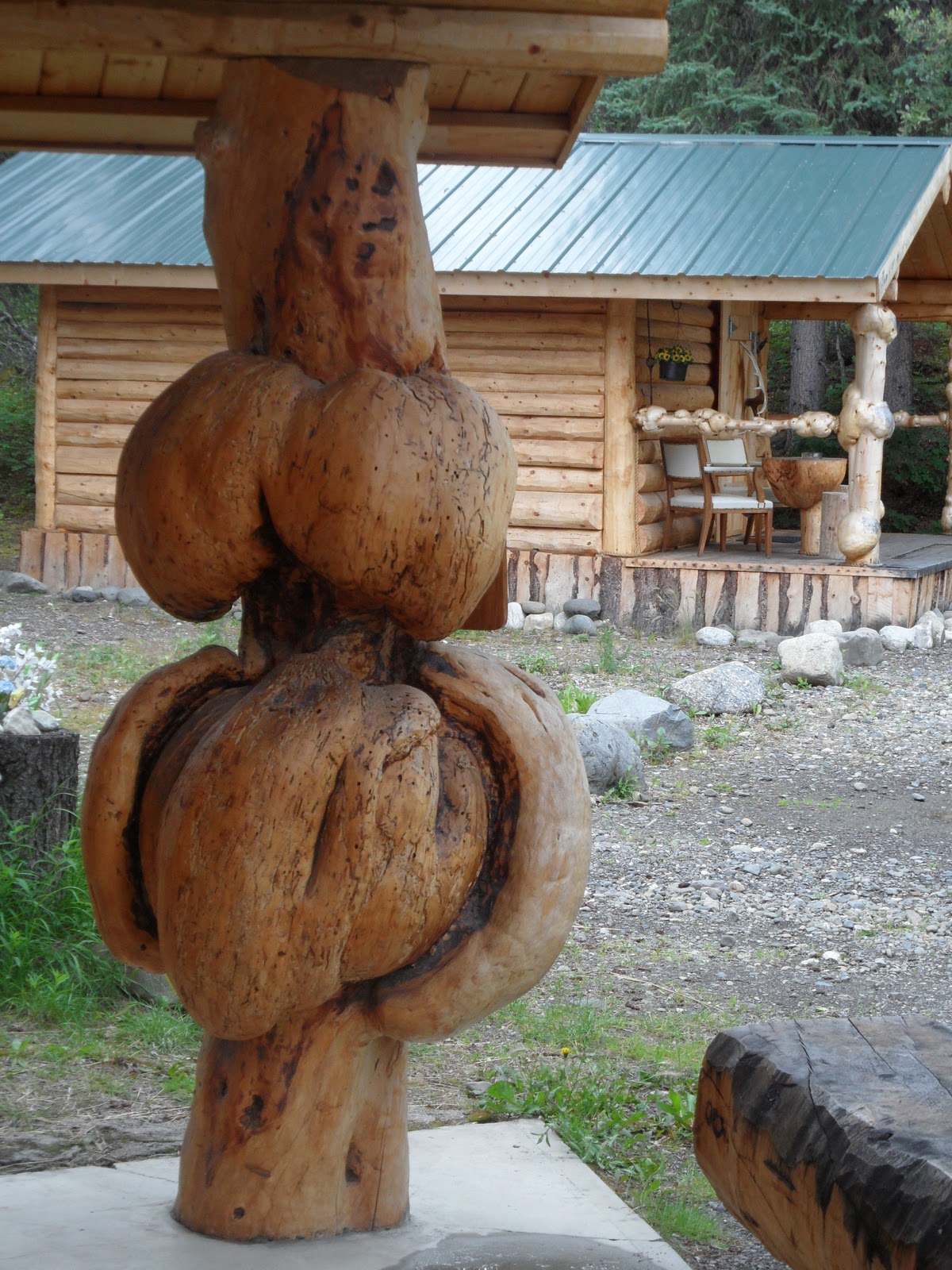
Apparently, using burled wood as a decorative element for EVERYTHING is big in Alaska.

I woke up early the next morning to the sound of my phone's alarm, a precaution to ensure that I made my 7:30 bus on time. Truth be told, I was awake even before it went off; I was thrilled to get the opportunity to see the innermost areas of a park that is legendary in this country, and, like a kid who can't wait to dash down the steps on Christmas morning, I was already wide awake at the crack of dawn.

I fired up the bike, navigated out of the campground, and shot north on Route 3 back to the park. Although still slightly overcast, the weather seemed to be breaking, and the potential was there to actually see blue skies, something I was learning to never take for granted in Alaska. When I arrived at the visitor's center, I realized that I wasn't the only person eager to get on the bus; a line was already forming where the buses pick up and drop off. It afforded me the time to eat the breakfast I had brought with me, and do a little people watching, as well. Soon the bus rolled up, and the odd assortment of tourists that had gathered climbed aboard.

The bus rolled leisurely through some of the most beautiful terrain I had come across since starting the trip, and my only regret was that I wasn't seeing it from my motorcycle. After so many miles on the bike, I had grown accustomed to the unobstructed, panoramic view that it provided, and seeing things from a bus window just didn't seem to do the park justice. Still, I made the most of what I had, and I was able to capture several astounding views that seemed to change as quickly as I could raise my camera.


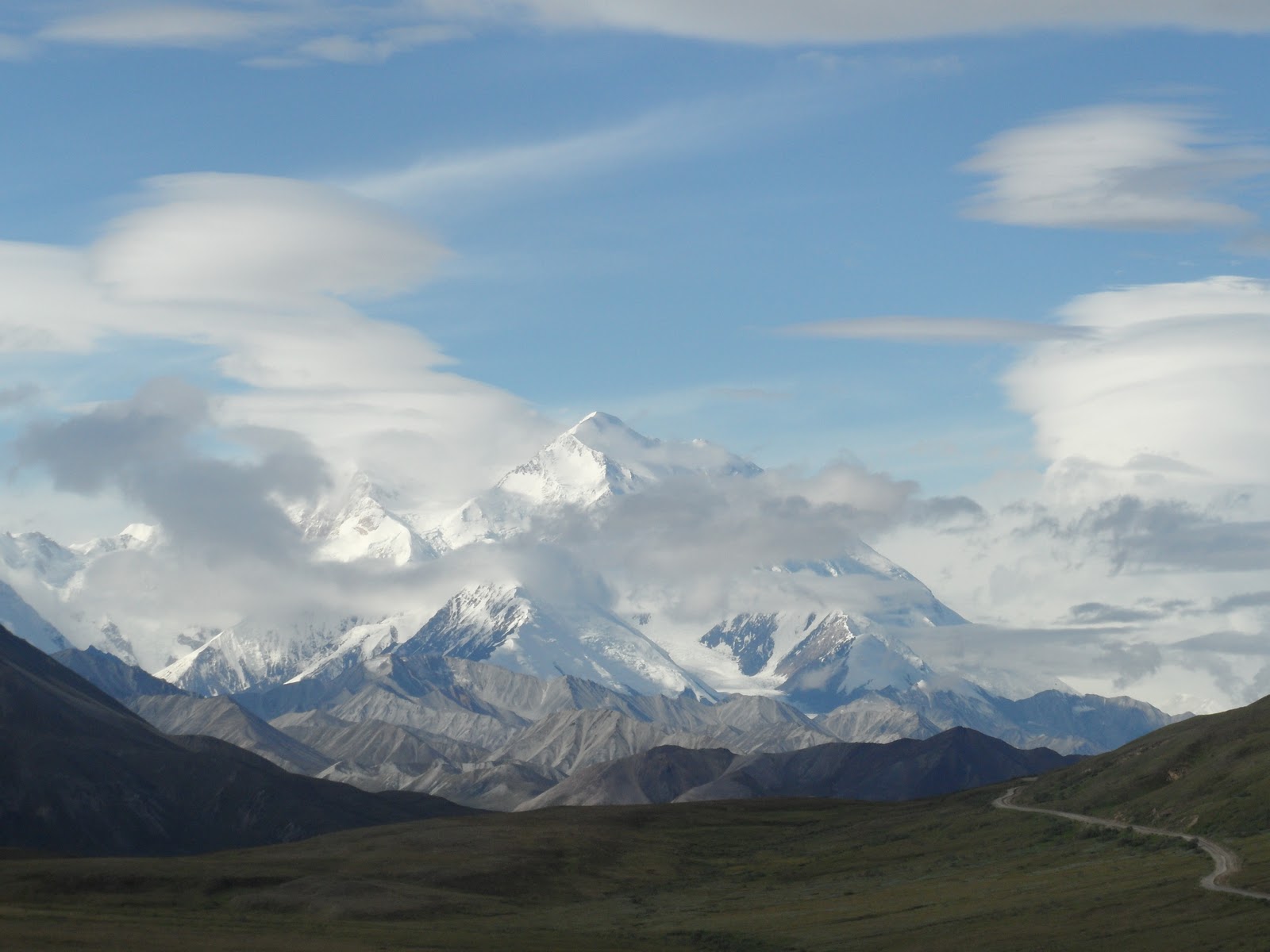
My first glimpse of Denali, or the "Great One". The bus was pretty far away, so it was only because of the 15x zoom on my camera that I was able to capture this shot.

I shake my head whenever I see this image, because I took this shot while the bus was moving, my camera jiggling around as I stuck it out the window. I can't believe that it even came out at all...

"Polychrome Pass" - a series of multicolored mountains formed by volcanic activity millions of years ago. WAY cooler in person, I promise...

Part of Denali National Park's appeal is the opportunity to see wildlife, and there was no shortage of that on the eight hour trip. Bears, moose, caribou, dall sheep; all oblivious to our presence as the bus sauntered through miles of the deepest regions of the park. Most of the animals were too far away to get adequate pictures, but a couple sitting across from me, obviously wildlife fanatics who kept listing and passionately discussing EVERY animal they had seen in the park since arriving several days earlier, would pass along their binoculars to me, and all of a sudden animals that were far off in the distance came into razor sharp view. The most thrilling was a brown bear with her three cubs, and the sheer size of them as they lumbered about left me speechless.

The final destination point before turning around was the Eileson Visitor's Center, 66 miles into the park, provided an awe-inspiring view of Denali mountain. As fate would have it, my battery had died right before arriving, so I popped it out of the camera, warming it with my hands in the hope that it would give me one more shot. At the lookout point of the center, with a rare, unobstructed view of the mountain range (only 30% of visitors to the park every year have weather that allows them to see the mountain), I took my last shot of the day before it gave out completely.


The ride back on the bus was quiet, as all of us were spent from the four hours it took to get out that far. Even the bus driver, who had graced us with entertaining stories for most of the ride out, was mostly silent, and at one point I even began to doze off. The silence was broken about an hour before arriving back at the main lodge when one of the passengers spotted a brown bear grazing less than 50 feet away from the road. Even though I had no battery power left to take what undoubtedly would have been some spectacular pictures, I was grateful to experience something so rare up close. As other tour buses began to stop, creating the equivalent of a national park traffic jam, our bus driver pulled away, passengers all around me still hanging out the window to take more pictures.

I rode back to my campsite exhausted from the long day, but completely satisfied from the experience. I decided to splurge that night for dinner, and I ate at a brick-oven pizza joint not far from the campground. I had not thought about how alone I had been during the trip, but sitting at a table by myself, surrounded by couples, families and large groups of tourists, I became acutely aware of my solitude. With only a little more than a month in, though, I was going to have to get used to it. Again, I found myself wondering how Ido and Shira, the Israeli couple I met back in Haines, were doing, but the likelihood of running into them from here on out was slim. I paid my bill and took the quick trip on the bike back to the campground. It had started to rain lightly, so I parked the bike under the lean-to and hunkered down in my tent for the night. Alone.